

Ground Report: BJP Rises, JDU Falls, But the People of Bihar Have Already Lost Again
In Bihar’s never-ending political circus, the 2025 Assembly elections have descended into a theatre of implosion, betrayal, and tactical demolition. What was initially thought of as a contest over vision, governance, and employment has degenerated into a free-for-all -- dominated by muscle power, money, and managed failures.
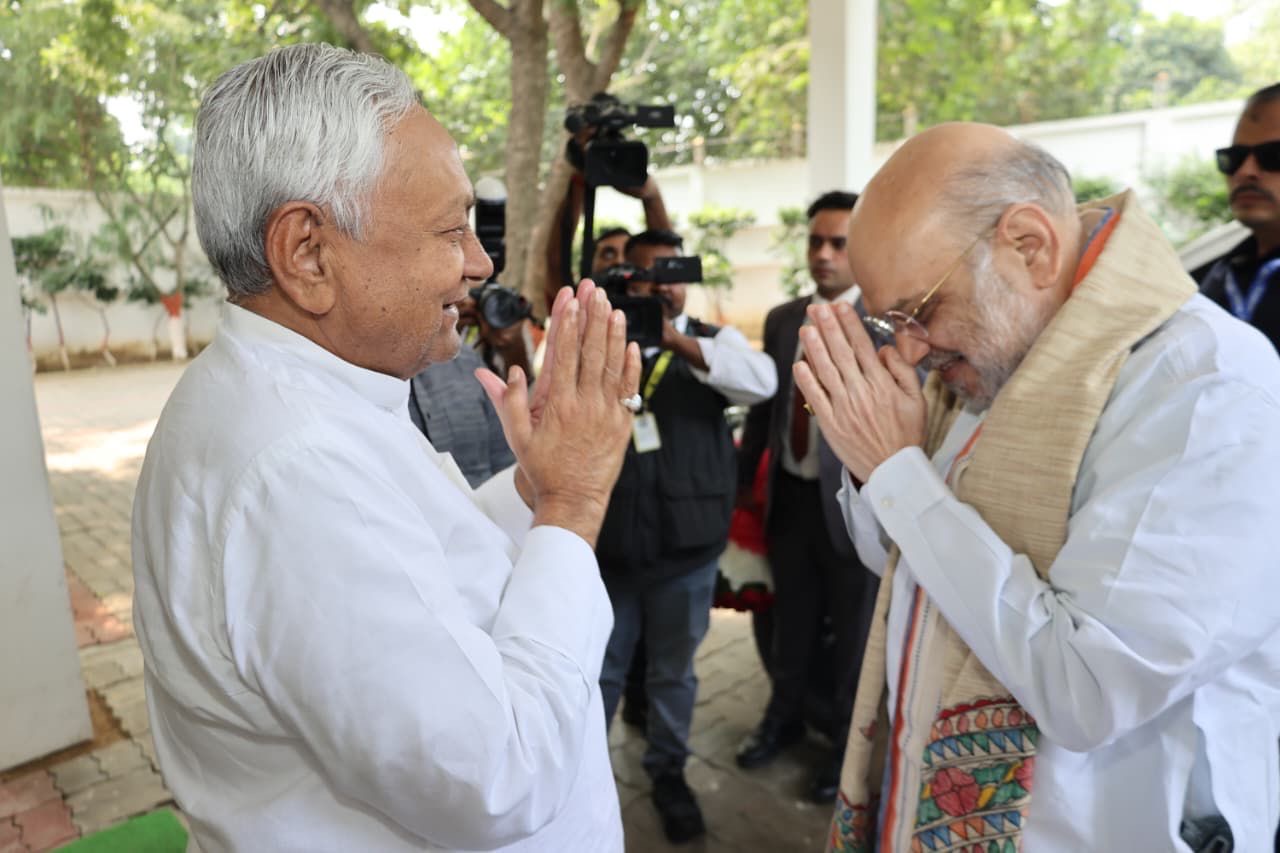 |
| Union Home Minister Amit Shah and Bihar CM Nitish Kumar. Pic via the former. |
This fall from grace is personal. For all of Nitish Kumar’s
earlier achievements, history will not remember him as the architect of Bihar’s
transformation but as the custodian of its stagnation. Under his watch, Bihar
continues to fare poorly across key indicators -- education, healthcare, per
capita income -- and worse still, he shielded individuals like Ashok Choudhary.
Accused of looting public funds, demanding commissions, and
amassing suspicious wealth, Choudhary represents everything that is wrong with
Bihar’s political culture. But, instead of being investigated, he has proven
again that in Bihar, loyalty to the power structure matters more than
integrity.
But why blame him alone? Bihar is not suffering from the rot
of one man’s actions. It is plagued by an entire ecosystem of bureaucratic
complicity, political negligence, and systemic sabotage. The truth is that
ministers like Ashok Choudhary thrive in a deeply cultivated culture of
unaccountability. Contractors, Sarkari babus and netas have perfected the art
of running Bihar like a private syndicate.
They float above laws, bypass oversight, and operate as
though public money is a private inheritance. Files vanish, audits are
stonewalled, and payments flow despite no work being done. This is a criminal
enterprise in slow motion, and every major political party has, at some point,
been either complicit or conveniently silent.
The latest Comptroller and Auditor General (CAG) report
tabled in the Bihar Legislative Assembly had laid bare the full scale of this
rot. Over ₹70,000 crore in public funds--yes, seventy thousand crore--are
unaccounted for due to the non-submission of Utilisation Certificates. Some of
these pending certificates date back over two decades.
But in the midst of this financial anarchy, Bihar government had the audacity to project a revenue surplus. As the CAG noted, even this surplus was a statistical farce--built on misclassified capital expenditure and off-budget borrowings. Capital expenses of over ₹3,000 crore were deliberately recorded under revenue heads, creating a mirage of fiscal health.
Meanwhile,
public sector undertakings were used as shadow banks to take on loans without
legislative oversight, flouting the Constitution and the Bihar Fiscal
Responsibility and Budget Management Act. This was a fiscal fraud at scale.
That no department has responded to the audit’s damning findings only confirms
that this is design. Structural failures like these are intentional, sustained,
and protected from the very top. And in such a framework, what hope remains for
the average Bihari, except that of betrayal dressed up as governance?
Returning to the election politics, BJP’s rise has been
ruthless but effective. By letting the JDU wither and rewarding LJP(R)’s Chirag
Paswan, the BJP has reinforced its dominance while grooming new allies. Chirag,
with his clean sweep in the 2024 Lok Sabha polls and his national cabinet role,
is no longer a fringe player. His positioning as a modern, pan-Bihar leader has
given NDA its only youthful edge. For the BJP, he is both an asset and an
insurance policy.
But this consolidation of power has come at the cost of
Bihar’s future. The RJD, the only party that could have countered BJP’s
momentum, is entangled in internal sabotage and old-school dynastic politics.
Ticket sales, alleged bribes, and the public meltdown of party loyalists like
Madan Shah reveal a deeper crisis of credibility. Tejashwi Yadav may be leading
the charge but beneath the surface, discontent is simmering and discipline has eroded.
As for the Congress, its journey in Bihar has now crossed
the line from tragic to farcical. What once was a party of ideological
conviction and mass mobilization has become a fragmented house, seemingly
incapable of recognising its own foot soldiers. The decisions taken in the name
of strategy this time reek of detachment from ground realities.
In constituency after constituency, long-standing Congress
loyalists who had devoted decades to defending the Nehru-Gandhi name on dusty
village roads and during politically hostile times have been cast aside in
favour of unknown faces--many of whom neither share the party’s ideological
history nor possess the bare minimum grassroots presence needed to contest, let
alone win.
One glaring example of this self-sabotage is the denial of a ticket to Gajanand Shahi, a veteran and fierce Congress voice who has spent over three decades speaking for the party in its darkest hours. From village panchayats to district rallies, Shahi was the one who kept the Congress flag flying when it was neither profitable nor popular to do so. He came within striking distance of victory in the last election and was widely seen as the natural choice this time. But, for reasons known only to the party high command, he was denied a ticket in favour of a political outsider whose only qualification appears to be proximity to some handler in Delhi.
The decision has
insulted every Congress worker who believed that loyalty and consistency still
mattered in Indian National Congress. His omission has also left a gaping wound
in the morale of party cadres across Bihar. The Indian National Congress, quite
shockingly, has also not seen what contribution can the man who has been
rewarded the ticket make to the welfare and upliftment of the people in the
constituency concerned. A boomer on life support who has already outlived his span has been ticketed in a constituency with more than 65 per cent population under the age of 35.
The result of this political miscalculation may be disastrous. By sidelining loyalists and rewarding outsiders, the Congress has essentially severed its last few lifelines in the state. Voters who were still willing to give the party a chance out of nostalgia or loyalty have been given no compelling reason to stay.
The 2025 Bihar Assembly election, for Congress,
risks becoming a historical erasure. More alarmingly for the leadership, the
cascading impact of such indifference could stretch far beyond Bihar. For Rahul
Gandhi, who hopes to lead a broader national revival by 2029, Bihar could
become a cautionary tale--a state where the Congress lost the last traces of its
relevance.
Meanwhile, Prashant Kishor’s Jan Suraaj began with promise
but faltered when it mattered. Despite rightly spotlighting governance gaps and
corruption, Kishor abandoned the battlefield at a time when his presence was
most needed. His retreat from direct contest from the very ground he claimed as
his karmabhoomi, is now being seen as a failure of courage. What remains now is
only an echo of what his movement could have been.
This election, in its current form, is no longer a
referendum on governance but a cynical game of managing collapses and
controlling narratives. Dynasts fill the ballot, grassroots voices are ignored,
and across parties, credible candidates have been replaced with placeholders
and power brokers. Anger on the ground is real -- voters across the board are
disgusted by the open allegations of seats being sold, of parties turning into
auction houses. In this chaotic election season, whoever wins, Bihar has
already lost.
The 2025 elections were supposed to be a chance to rewrite
Bihar’s script. Instead, they’ve cemented the state’s position in a dark
chapter -- where education is sidelined, healthcare crumbles, and political
survival is bought and sold. No one talks about fixing the state anymore; they
just want to win it.
For the people of Bihar, the next five years promise more of
the same: symbolic leadership, hollow slogans, and a growing distance between
promises made and problems ignored. In that sense, the real loser of Bihar 2025
isn’t Nitish Kumar, or Tejashwi, or Prashant Kishor. It’s the voter.