

Putin–Modi Summit Seals 29 Crucial Pacts as India and Russia Recast Strategic Ties for a Multipolar World
In a summit thick with strategic symbolism and sweeping bilateral action, Russian President Vladimir Putin and Indian Prime Minister Narendra Modi signed 29 agreements and issued a joint declaration pledging to elevate their “time-tested progressive partnership” into a deeper geopolitical alignment rooted in sovereignty, stability, and multipolarity.
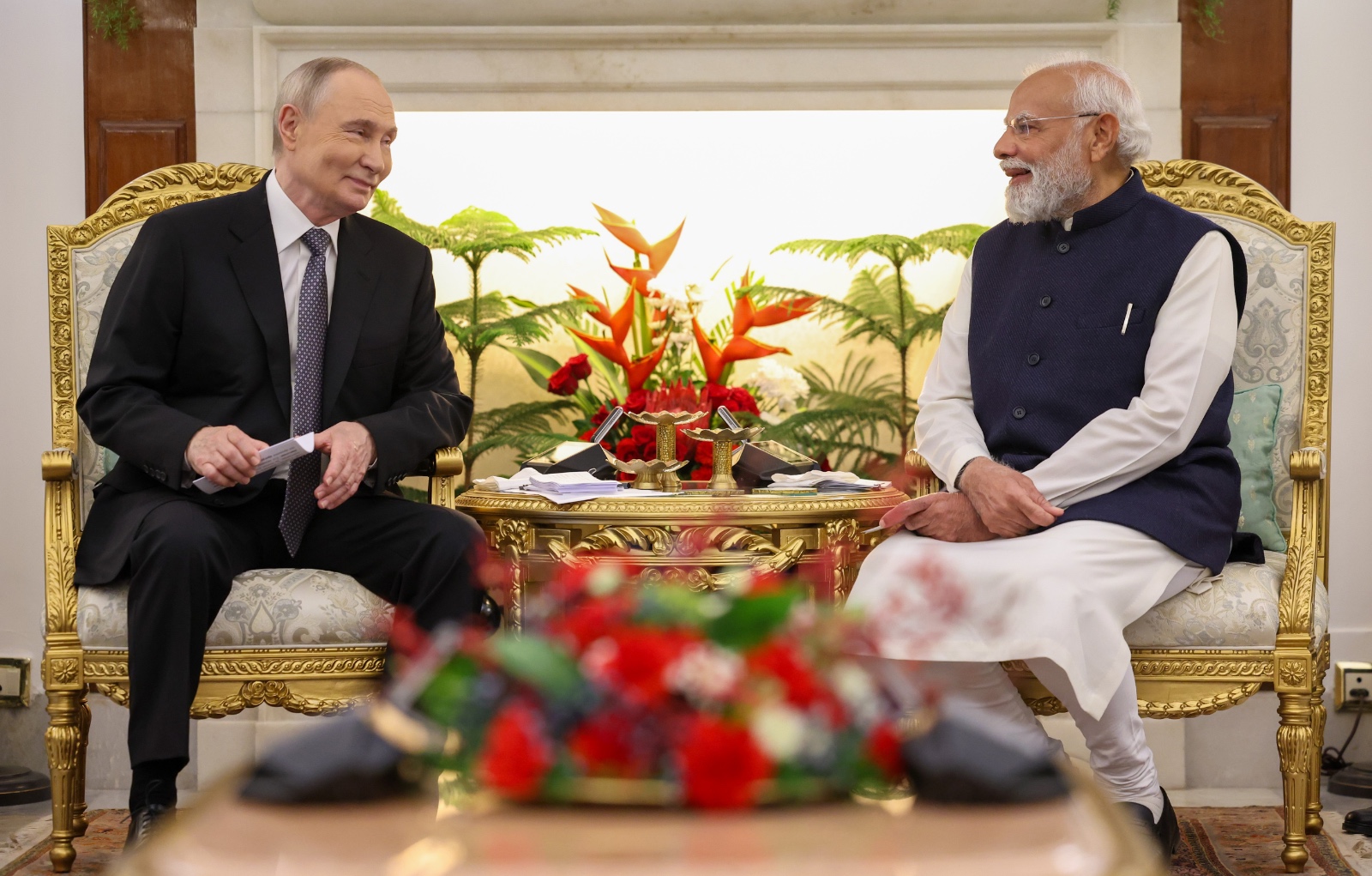 |
| Indian PM NaMo with Russian Prez Putin |
This is a forward-looking document that defines new rules of engagement across trade, defence, energy, migration, and critical technologies amid shifting global power centres.
The two leaders met at Hyderabad House for in-depth talks before witnessing the signing of wide-ranging intergovernmental and institutional agreements, including on labour mobility, nuclear and space cooperation, critical minerals, and dual-language broadcasting.
With both countries navigating Western sanctions and economic realignments, the summit underlined mutual intent to reduce dependency on the West by building parallel systems—financial, strategic, and technological—through bilateral and multilateral platforms such as BRICS and the SCO.
Among the most consequential takeaways was the formal agreement to jointly develop bilateral payment systems using national currencies, and integrate financial messaging and central bank digital currency platforms.
This financial architecture, both leaders signalled, will underpin efforts to push bilateral trade from its current $65–70 billion to $100 billion by 2030.
India’s concern over trade imbalance was formally acknowledged, with Russia agreeing to explore wider market access for Indian goods and services, and commit to long-term supplies of critical inputs such as fertilisers, oil and gas, and strategic minerals.
Putin and Modi also oversaw the signing of migration-related pacts, including new frameworks to enable temporary employment of citizens across borders, and joint action to combat illegal migration.
In the energy sector, the leaders assessed ongoing Russian investments in Indian oil refining and petrochemicals, reaffirmed cooperation in nuclear power—especially at the Kudankulam plant—and endorsed the identification of a second Russian-assisted site for future nuclear installations in India.
Both sides reiterated their shared commitment to secure and diversified energy supply chains, including liquefied natural gas and new nuclear technologies.
Defence and military cooperation remained a core pillar of the summit. The leaders welcomed the shift from a buyer–seller dynamic to joint design and co-production under India’s “Make in India” framework.
Technology transfer, joint ventures for spares and components, and expanded cooperation on platforms such as the Su-30MKI and S-400 systems were noted.
The Russian side affirmed support for India’s defence manufacturing ambitions, with potential for joint exports to third countries.
In space cooperation, the summit registered concrete movement: both sides agreed to deepen cooperation on satellite navigation, human spaceflight, and the use of Russian rocket engine technology.
A new agreement was signed on data storage, processing and transmission in space systems, while educational MoUs between leading universities signalled joint intent to build academic and technological talent pools across both countries.
Culture and broadcasting featured prominently, with India’s public broadcaster Prasar Bharati entering five separate cooperation agreements with major Russian media houses, including RT and Gazprom-Media.
A new bilateral exhibition titled “India. Fabric of Time” will open in Moscow, while an MoU was signed to jointly produce alcoholic beverages.
A logistics agreement on the Chennai–Vladivostok corridor and an MoU on training polar vessel crews reflect growing focus on the Russian Far East and Arctic.
Multilateral cooperation was strongly foregrounded. Russia reaffirmed its support for India’s permanent seat at the UN Security Council and its upcoming 2026 BRICS presidency.
Both sides endorsed UN reform, a representative G20, and the expansion of BRICS as necessary steps toward equitable global governance.
Shared positions on climate, food security, and economic reform were reflected in the joint statement’s support for India-led initiatives like the International Big Cat Alliance, and the continued push for technology access and climate financing for the Global South.
On terrorism, Modi and Putin delivered their strongest language yet. Citing attacks in Jammu and Kashmir and Crocus City Hall in Moscow, both sides condemned terrorism “in all its forms and manifestations,” called for the elimination of safe havens and funding networks, and reiterated zero tolerance.
The joint statement stressed the importance of early adoption of the stalled Comprehensive Convention on International Terrorism and welcomed the Delhi Declaration on countering new tech-enabled terrorism adopted under India’s UNSC chairmanship.
The joint declaration also stressed shared concerns on the situation in Afghanistan, called for restraint and humanitarian access in Gaza, and emphasized the need for peaceful resolution of global crises through dialogue and international law.
The joint reference to multipolarity was deliberate and recurrent, with both sides defining the India–Russia partnership as a stabilizing force in a fragmenting world order.
Putin, whose visit marked 25 years since his first summit in India in 2000, thanked Modi for what he described as “special personal attention” to the relationship. Modi, in turn, presented the Russian leader with a Russian translation of the Bhagavad Gita, saying its teachings inspired harmony and peace.
In a final gesture, Putin invited Modi to Russia in 2026 for the next annual summit, signaling continuity in a relationship both leaders have carefully curated over two decades of global transformation.
Also Read:
India Hosts Putin as Strategic Moscow-Delhi Ties Deepen Amid Ukraine War and Building US Pressure