

Putin–Modi Pact Anchors $100 Billion Vision as India and Russia Sign Landmark 2030 Economic Roadmap
Amid intensifying global fragmentation and rising strategic autonomy across the Global South, Russian President Vladimir Putin and Indian Prime Minister Narendra Modi signed a landmark roadmap to deepen their bilateral economic engagement through 2030, aiming to take trade beyond $100 billion.
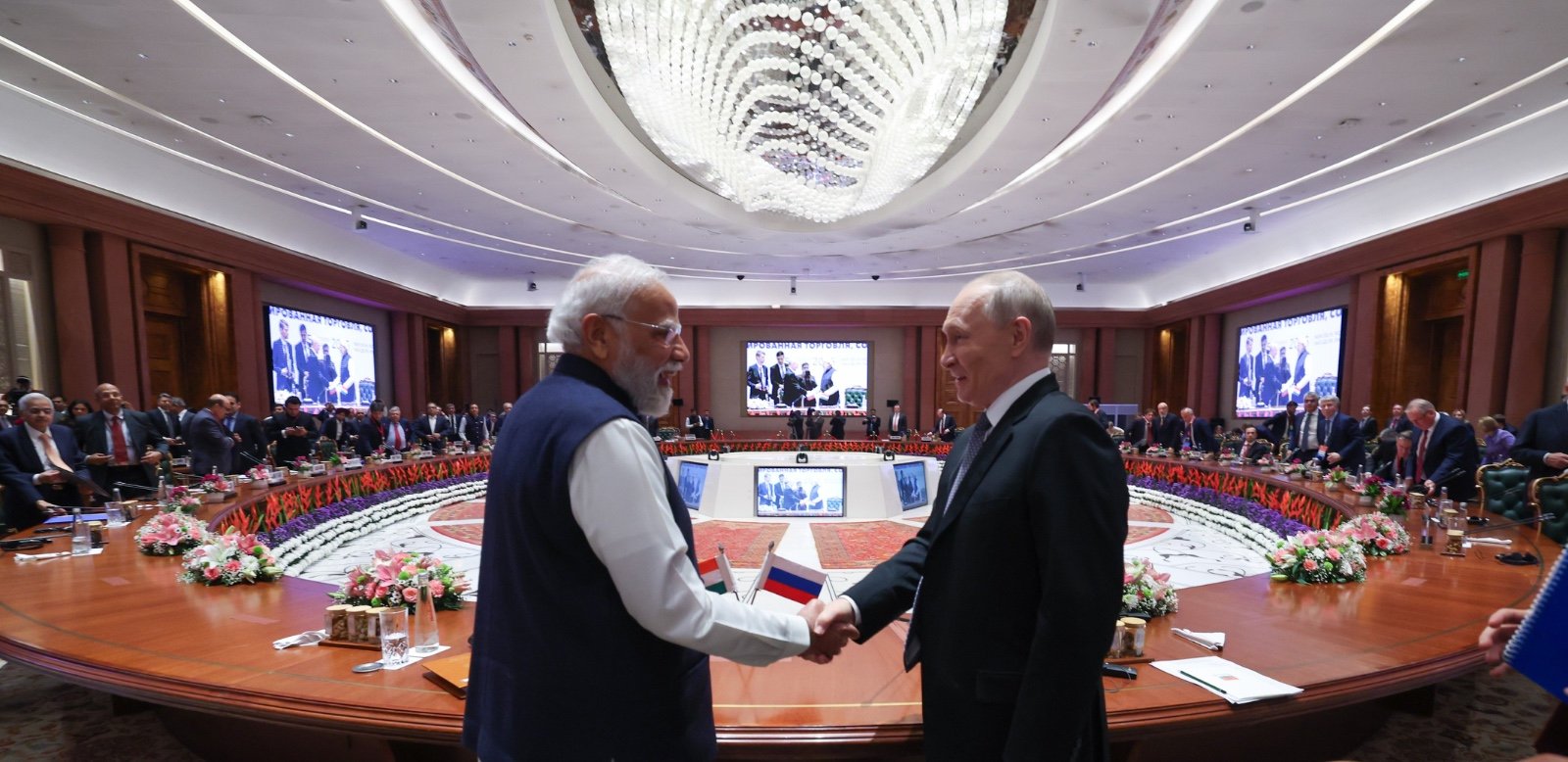 |
| Prez Putin and PM NaMo attended the Plenary Session of the India-Russia Trade Forum |
The summit, Putin’s first visit to India since the Ukraine war began, saw both leaders publicly reaffirm the “Special and Privileged Strategic Partnership” between their countries, even as global alignments continue to shift.
“India-Russia ties have stood the test of time,” Modi said, thanking the Russian president for what he described as decades of “unwavering personal commitment.”
Putin called the partnership “deeply rooted in mutual respect and civilizational identity,” and emphasized that both countries now pursue “independent foreign policies in favour of a fair multipolar world.”
The newly signed roadmap outlines structural reforms to boost trade and investment volumes, diversify cooperation, and ease cross-border flows of goods, services, capital and labour.
It comes at a time when bilateral trade, while growing, remains lopsided—standing at around $65 billion in 2024–25, with India pushing for greater access for its exports.
Putin acknowledged the imbalance and pledged that Russian enterprises would increase imports of Indian goods and services. He also pointed to the successful transition to national currencies, noting that 96% of mutual trade is now conducted in rupees and rubles.
To reduce non-tariff barriers and streamline logistics, both countries agreed to expedite work on a Free Trade Agreement between India and the Eurasian Economic Union, and expand transport corridors such as the International North–South Transport Corridor and the Chennai–Vladivostok route.
Putin underscored Russia’s readiness to use Arctic and trans-Arctic shipping lanes for Indian exports, while India signed new MoUs on maritime training in polar waters and shipbuilding.
A strong push for energy security and high-tech cooperation was visible across the summit outcomes. Russia reaffirmed long-term oil and gas supplies and joint work on nuclear energy, with Kudankulam’s expansion noted as a “flagship project.”
New proposals were floated for small modular and floating nuclear reactors. Cooperation in critical minerals—including rare earths essential to green energy and semiconductors—was highlighted as a pillar of future industrial and clean energy resilience.
Two major agreements were signed on temporary labour mobility and combating irregular migration, with both sides terming manpower flows a core strength of the partnership.
Modi said the agreements would unlock youth employment and skilling in areas like shipbuilding and Arctic operations, while facilitating new student, academic, and professional exchanges. A reciprocal 30-day free e-tourist visa and group visa regime for Russian citizens was also announced.
In health and agriculture, India and Russia inked agreements on joint urea production, medical education, food safety, and pharmaceuticals.
A Russian–Indian oncology drug manufacturing facility in Kaluga was announced, using Indian technology to produce high-value medicines. Cooperation in medical technology, AI-based diagnostics, and food safety compliance will follow.
India’s public broadcaster Prasar Bharati signed five separate MoUs with leading Russian media groups, including RT and Gazprom Media, in what was described as a “deepening of civilizational communication.”
Putin noted the formal launch of RT’s India channel and praised India’s leadership in using media to “counter disinformation and build cross-cultural understanding.”
The business forum that followed the summit saw major announcements by both leaders. Putin described India’s economy as one of the most “independently and dynamically growing in the world,” praising Modi’s Make in India policy and confirming Russian investment in Indian manufacturing.
Modi said the $100 billion trade target was “ambitious but achievable,” and pushed for new Indian exports to Russia across food, agriculture, pharma, electronics, and consumer goods.
Beyond economics, the two leaders touched on geopolitics. Both condemned terrorism “in all its forms,” linking recent attacks in Jammu & Kashmir and Moscow’s Crocus City Hall, and called for global unity against terror networks.
On Ukraine, Modi reiterated India’s position that peace must come through dialogue and diplomacy, saying India supports “all efforts toward a durable solution.”
Putin thanked India for its engagement and said Moscow was working with “partners, including the United States” on a possible peace framework.
Both sides reaffirmed strong coordination in forums such as BRICS, the SCO, the G20, and the UN. Russia confirmed its full support for India’s permanent membership at the UN Security Council and pledged assistance for India’s BRICS presidency in 2026.
India welcomed Russia’s decision to join the International Big Cat Alliance, and announced a joint cultural exhibition titled India: Fabric of Time in Moscow.
Also Read:
India Hosts Putin as Strategic Moscow-Delhi Ties Deepen Amid Ukraine War and Building US Pressure