

Slay It Like Sassy: Tharoor Attends Putin State Dinner Amidst Opposition Snub, Maintains Quiet Legislative Momentum
Even as Congress MP Shashi Tharoor’s presence at the state dinner for Russian President Vladimir Putin drew national headlines, it is his continued legislative activity in Parliament that continues largely unnoticed in the public discourse.
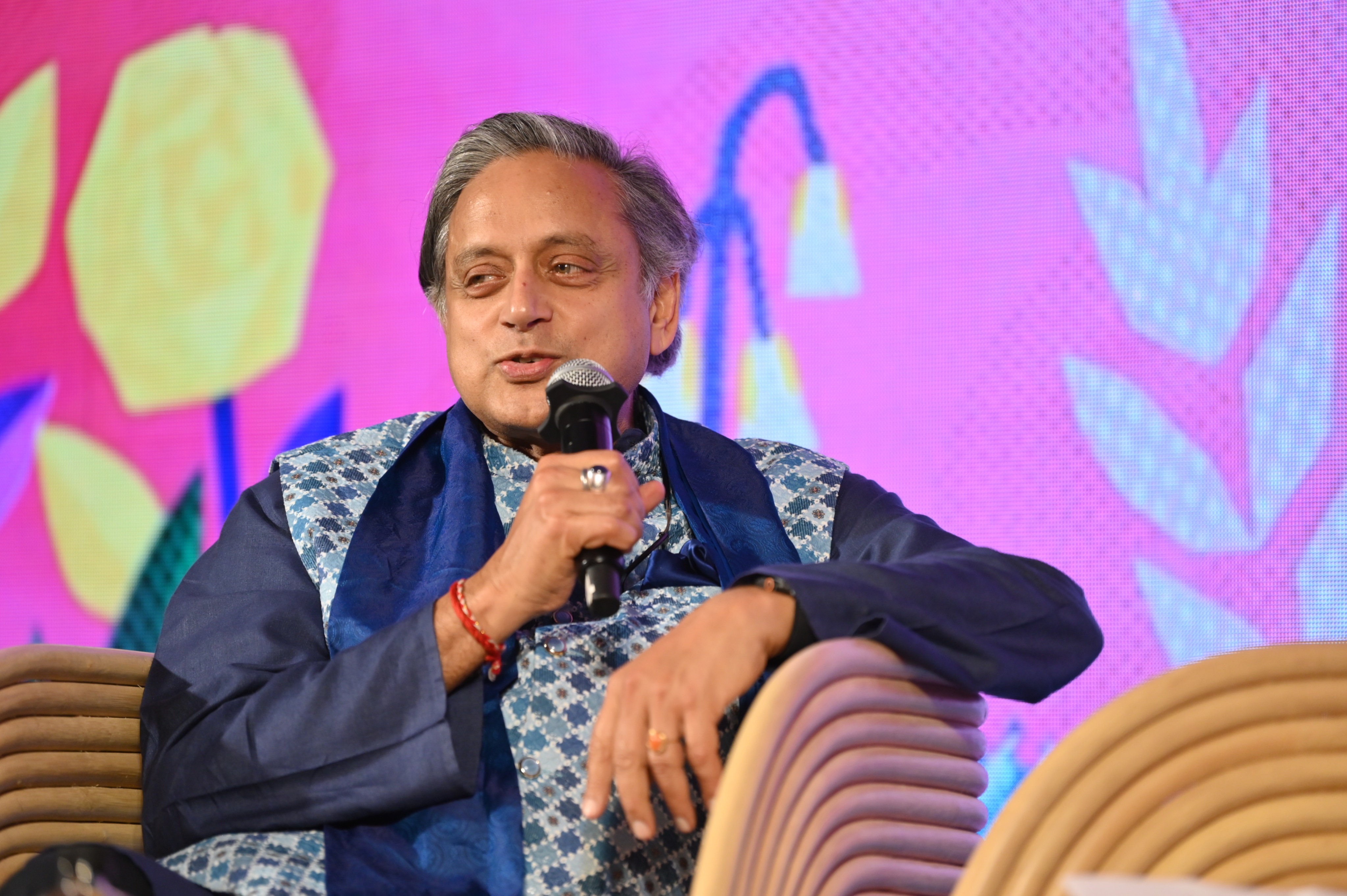 |
| Image Source: Bangalore Lit Fest on X |
His decision to attend drew internal criticism from party spokesperson Pawan Khera, who stated that “those who extended such an invitation raise questions, and those who accepted are also open to scrutiny.”
But behind the scenes, Tharoor has been consistently active on key policy matters in Parliament. In recent weeks, he introduced several Private Members' Bills and raised detailed parliamentary questions across sectors ranging from urban development and competition regulation to labour rights and gender justice.
Among his most significant interventions was a pointed question on the implementation of the Pradhan Mantri Awas Yojana-Urban (PMAY-U) in Kerala. The Union Housing Ministry revealed in response that Kerala is the only state yet to sign the MoU for PMAY-U 2.0, potentially denying 2–3 lakh beneficiaries access to pucca housing.
Tharoor also spotlighted the issue of delayed fund releases and the alleged non-compliance with fire safety in centrally funded urban housing schemes.
In the corporate policy domain, he sought clarity from the Ministry of Corporate Affairs on the fall in green channel filings before the Competition Commission of India (CCI).
The government responded with data showing an increase in filings from 19% to 22% between 2020–21 and 2023–24, while also addressing concerns about the restrictive interpretation of new rules involving Ultimate Controlling Persons (UCPs).
Tharoor also introduced a landmark bill advocating for the "Right to Disconnect" and legal limits on working hours, citing International Labour Organization data that 51% of Indian workers clock over 49 hours a week.
The proposed legislation addresses work-life balance, mental health, and occupational protections for all categories of employees, including contractual staff.
In another legislative initiative, he proposed criminalising marital rape by amending the Bharatiya Nyaya Sanhita, 2023, which currently exempts non-consensual sex within marriage from prosecution.
Tharoor argued this exception undermines women's bodily autonomy and violates both domestic and international human rights obligations. His bill draws on data from the National Family Health Survey and recommendations from the Justice Verma Committee Report (2013).
Additionally, Tharoor has called for a systematic mechanism for the reorganisation of large Indian states, referencing historical precedents such as the creation of Uttarakhand and Telangana.
His proposed bill seeks a structured framework based on administrative efficiency, cultural identity, and economic viability to avoid ad-hoc bifurcations.
In a formal submission under Rule 377, Tharoor also raised the issue of the denial of Ex-Servicemen (ESM) status to Military Nursing Service (MNS) officers, which was reportedly reversed by the Supreme Court in April 2025 but yet to be enforced by the government. He urged the Defence Ministry to act promptly in restoring rightful benefits to MNS personnel.
While it may be true that national attention is once again fixated on Shashi Tharoor’s presence at high-profile diplomatic events, it is equally important to acknowledge the parallel arc of his legislative record and public engagement. His consistent contributions in Parliament, from raising detailed queries on economic, defence, and welfare policy to introducing private member bills addressing complex issues like work-life balance, state reorganisation, and marital rape, reflect a sustained commitment to institutional processes.
Beyond the Lok Sabha, his regular columns and televised appearances offer a rare blend of intellectual clarity and accessibility in public discourse. This layered participation signals both experience and an underleveraged capacity for national leadership that is rooted in both diplomatic training and legislative substance.
His is a profile increasingly uncommon in Indian politics today.