

A Buffalo Is A Family's Savings Account And India Is Trying To Insure It Online
India's new livestock insurance portal covers policy issuance and claims in 13 languages, with more than 30 lakh animals insured so far this year. (Updated)
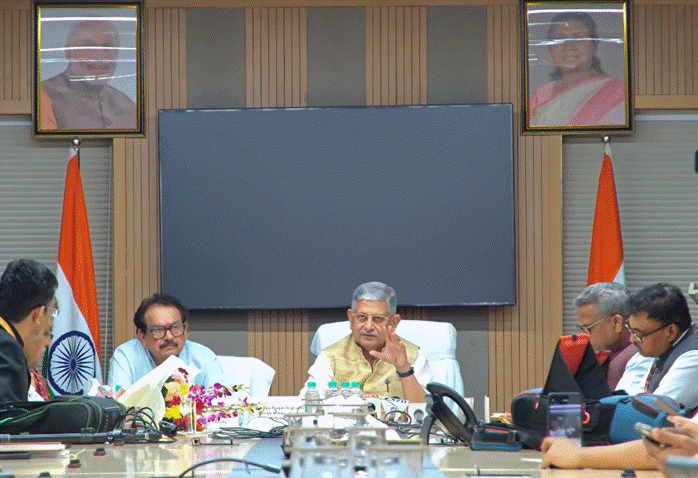 |
| Image Source: PIB India |
The Indian government launched a national online portal for livestock insurance on Monday, consolidating policy issuance, claims and monitoring on a single platform available in 13 languages. Rajiv Ranjan Singh, known as Lalan Singh, the union minister for fisheries, animal husbandry and dairying, launched the portal in New Delhi at rashtriyapashubima.dahd.gov.in. The minister of state, S P Singh Baghel, and the animal husbandry secretary, Naresh Pal Gangwar, were present, along with state government officials and representatives of insurance companies. More than 4,000 people joined online.
Gangwar said more than 30 lakh animals, over three million, have been insured during the year under the scheme.
The portal covers animals insured under the Livestock Insurance activity of the National Livestock Mission, and will be available in Hindi, English and 11 regional languages so that farmers can use it in the language they speak. That last detail is less bureaucratic than it sounds. About 10.08 crore Indian households, more than 100 million, keep livestock or poultry. Many are in states where neither Hindi nor English is the working language of the home, and an insurance product that exists only in either is, for practical purposes, unavailable.
For these households the stakes are unlike those of crop insurance. A buffalo or a pair of milch cows is simultaneously an income stream, a savings account and collateral for a loan. Livestock contributes around five per cent of India's gross value added, and the country is the world's largest producer of milk. When an animal dies of disease, injury or flood, a family can lose its principal asset in a single day, and unlike a crop farmer it cannot diversify or plant something hardier next season.
India has run a livestock insurance scheme since a pilot in 100 districts in 2005-06. The terms have been steadily softened. Under the National Livestock Mission, the farmer's share of the premium was cut to 15 per cent from a range that had run between 20 and 50 per cent, with the rest split between the central and state governments: 60:40 in most states, 90:10 in Himalayan and north-eastern states, and borne entirely by the centre in union territories. The number of animals a household can insure was raised from five cattle units to ten, a cattle unit being one large animal such as a cow or buffalo, with a separate ceiling of five for pigs and rabbits.
Despite this, take-up has remained low. One assessment by the Sri Sathya Sai Institute of Higher Learning's Centre for Applied Data Science put livestock insurance penetration in India at 0.98 per cent, which is to say that better than ninety-nine animals in a hundred are uninsured. Set against the 10.08 crore households that keep animals, the 30 lakh insured this year works out at roughly one animal for every thirty-four such households.
The reasons for the gap are familiar to anyone who has watched insurance markets in rural economies. Claims require proof that the animal that died is the animal that was insured, which historically meant ear tags, photographs, veterinary certificates and post-mortem reports, assembled by a grieving farmer and submitted to an office some distance away. Settlements have been slow. Awareness has been patchy. A subsidised premium does not help much if the farmer expects the claim to fail.
The department said the new platform offers an end-to-end system covering policy issuance, premium management, claim processing, beneficiary verification and real-time monitoring, bringing farmers, state governments, insurers and implementing agencies onto a single interface. It expects the portal to speed up enrolment, improve transparency in claim settlement, allow policies to be tracked in real time and support better data on how the scheme is working.
This is where a portal could matter. Digitising issuance and claims addresses one specific failure, the friction, and gives the department something it has not had, a real-time national picture of who is insured and which claims are stuck. Whether that translates into coverage depends on things a website cannot fix: whether state governments push the scheme, whether insurers price it to sell, and whether the first cohort of farmers who file claims are paid promptly enough to tell their neighbours.
Minister Singh appeared to acknowledge as much. He told the gathering that awareness programmes were needed so farmers could get the maximum benefit, and urged insurance companies, state governments and other stakeholders to publicise the scheme more widely through social media and outreach campaigns.
"Technology should be used in Digital India, and the livestock insurance portal is in line with that," he wrote on X after the launch. He said Prime Minister Narendra Modi had consistently directed that attention be paid to raising farmers' incomes and productivity and to strengthening their economic and social security, and that services should be easy to use and transparent.
आदरणीय प्रधानमंत्री श्री @narendramodi जी सदैव निर्देशित करते रहते हैं कि इस पर ध्यान देना चाहिए किसानों की आय कैसे बढ़े, उत्पादकता कैसे बढ़े, उनकी आर्थिक सामाजिक सुरक्षा कैसे मज़बूत हो।
— Rajiv Ranjan (Lalan) Singh (@LalanSingh_1) September 28, 2026
लोगों को टेक्नोलॉजी आधारित सुगम सेवा और पारदर्शी सेवा उपलब्ध होनी चाहिए।
डिजिटिल इंडिया… pic.twitter.com/H4eYiO67zk
Baghel said the uncertainty of agriculture was a concern and that he hoped the portal would bring relief to farmers. India has form here. The digital public infrastructure built over the past decade, from identity to payments, has moved large numbers of people into formal systems by lowering the cost of enrolment rather than by changing the underlying product. Applying that logic to livestock insurance is a reasonable bet.