

Modi’s Charge vs Priyanka’s Counter: Vande Mataram Debate Reopens Old Faultlines, Fuels New Flashpoints Ahead of Bengal Polls
In a high-stakes Lok Sabha debate marking 150 years of the national song Vande Mataram, Prime Minister Narendra Modi launched a fierce historical critique against the Indian National Congress, accusing it of compromising the legacy of the song during the pre-independence era. His speech, which traced Vande Mataram’s journey from Bankim Chandra Chattopadhyay’s pen in 1875 to its role as a galvanizing force in India’s freedom struggle, sparked a sharp counterattack from Congress MP Priyanka Gandhi Vadra, who alleged deliberate historical omissions and political motives behind the ruling party’s narrative.
 |
| Image Source: TheSincereDude on X |
“Congress bowed before the Muslim League and decided to fragment Vande Mataram,” Modi declared, accusing the party of repeatedly prioritizing appeasement over national unity.
Modi invoked figures such as Khudiram Bose and Madanlal Dhingra, describing how revolutionaries went to the gallows with Vande Mataram on their lips. He emphasized the song’s power to unite India across language and region, linking its suppression by the British to its revolutionary potential.
Citing Rabindranath Tagore, Veer Savarkar, and even foreign-based publications like Madam Bhikaji Cama’s Vande Mataram newspaper from Paris, Modi presented the song as a cultural weapon of resistance and unity, until, he argued, politics intervened.
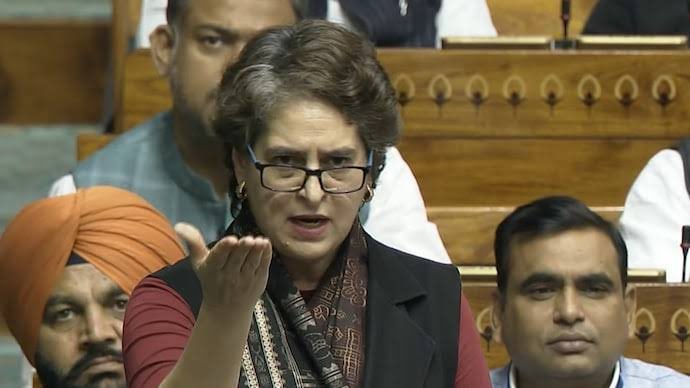
But Priyanka Gandhi Vadra challenged both the substance and the motivation of the Prime Minister’s intervention, accusing him of weaponizing history for political ends, particularly with an eye on the upcoming West Bengal elections.
“There are only two reasons for this debate — elections are coming in Bengal and you want to exploit this emotionally charged symbol to score political points,” she said.
She defended Nehru and the Congress’s actions in the 1930s, providing fuller context to the internal party debates over the communal sensitivity of the full song. Quoting from original correspondence between Nehru and Subhas Chandra Bose, she highlighted that while the Congress was mindful of communal harmony, it never intended to undermine the emotional and national power of the song.
“Jinnah’s objections were manufactured. Nehru didn’t agree with them — he said we must not pander to communalists. That was also part of the letter,” she noted.
Priyanka Gandhi also reminded the House that it was at a Congress convention in 1896 that Vande Mataram was first sung publicly by Tagore.
“Was it RSS? Was it Hindu Mahasabha? Why don’t you acknowledge it was the Congress?” she asked pointedly, calling the Prime Minister’s version of history “selective and misleading.”
She further noted that in 1950, the Constituent Assembly, in the presence of Dr Rajendra Prasad, Sardar Patel, Ambedkar, Shyama Prasad Mukherjee, and others, had unanimously accepted the first two stanzas of Vande Mataram as the national song — a decision never challenged at the time.
The debate, stretching nearly 10 hours, saw other Congress leaders like Gaurav Gogoi also weigh in. Gogoi accused the Prime Minister of revising history for partisan gain, noting that Modi referenced Nehru 14 times and the Congress over 50 times during the recent “Operation Sindoor” and Constitution Day discussions.
“This wasn’t a tribute to Vande Mataram — it was an ideological re-litigating of 20th-century Congress decisions,” Gogoi said.
The deeply polarised exchange marks a sharp politicisation of a symbol long considered sacred across ideological lines. While Modi framed the Congress’s actions in the 1930s as symptomatic of a deeper betrayal, Priyanka positioned the Congress as the custodian of inclusive nationalism that acknowledged India’s plural realities while still honouring Vande Mataram’s power.
But both sides sought to claim the legacy of Vande Mataram, one through a lens of historic grievance and revival, the other through a narrative of complex, plural history.
In doing so, the debate exposed the sharply divergent visions of nationalism animating Indian politics today. With Bengal elections looming and questions of cultural identity dominating public discourse, Vande Mataram has once again become a contested battlefield of ideas.