

Quad Counterterrorism Talks in Delhi Signal Coordinated Push Against Cross-Border Terror Threats in Indo-Pacific
Meeting under the shadow of recent attacks in India, the Quad’s Counterterrorism Working Group (CTWG) convened for its third high-level session in New Delhi this week. The gathering signaled a sharpened joint resolve to confront evolving terrorist threats across the Indo-Pacific region.
Senior officials from India, Australia, Japan, and the United States gathered on December 4–5, 2025, to reinforce the framework of cooperation that has come to define the Quad’s expanding security agenda.
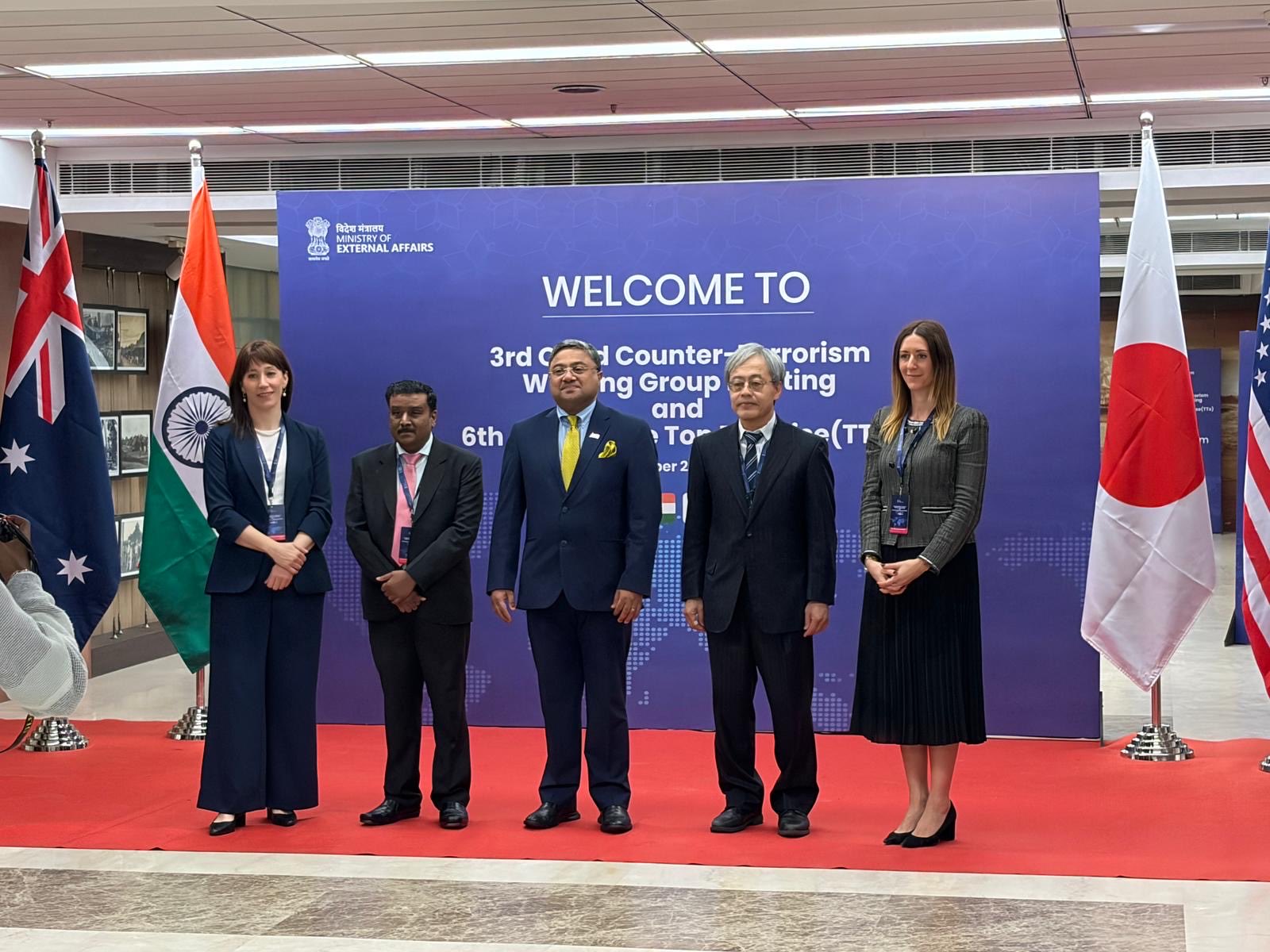 |
| Image Source: Gemma Huggins, Australia's Ambassador for Counter-Terrorism |
Ambassador Sibi George, Secretary (West) at India’s Ministry of External Affairs, opened the meeting with a pointed call to strengthen the Quad’s collective capabilities.
“The time has come to forge a common resolve within the Quad to combat the scourge of terrorism,” he said, thanking member states for their solidarity in the aftermath of the April 22 Pahalgam attack and urging the group to build a “resilient, robust and action-oriented” counterterrorism platform.
The delegation-level discussions were led by Dr. Vinod Bahade for India, Ms. Gemma Huggins for Australia, Mr. Minami Hiroyuki for Japan, and Ms. Monica Ager Jacobsen for the United States.
The officials presented updated assessments of the terrorism landscape, with specific attention to regional trends and cross-border threats that challenge the Indo-Pacific’s security architecture.
In a joint statement, the four nations unequivocally condemned terrorism in all its forms and manifestations, including cross-border terrorism, and called for concerted international action to bring perpetrators to justice.
Condolences were expressed for the November 10 terror attack near the Red Fort in Delhi, and the group called on all UN member states to cooperate in identifying and prosecuting those responsible for the violence.
The CTWG discussions included a Tabletop Exercise (TTx) focused on counterterrorism operations in urban environments.
Officials from the four countries shared operational best practices, scenario planning techniques, and strategic readiness models to improve real-time coordination in the face of increasingly complex terrorist threats.
The Quad’s message was also technological. Building on workshops hosted by India in September, including sessions on unmanned aerial vehicle (UAV) threats and the use of emerging technologies in terror financing, the group underscored the urgency of tracking and pre-empting tech-enabled terrorism.
These workshops, organized by the National Security Guard and National Investigation Agency, in coordination with India’s Ministry of External Affairs, are seen as early efforts to build inter-agency understanding of how modern terrorism is adapting to digital and autonomous platforms.
Crucially, the CTWG reaffirmed the importance of open information exchange on terrorist groups and proxies operating in the region, particularly those exploiting state sponsorship or safe havens to conduct transnational attacks.
The statement did not single out specific countries, but the reference to cross-border terrorism and the timing of the talks come amid growing international focus on Pakistan-based terror infrastructure and the changing security dynamics in South Asia.
The Quad members also emphasized the value of coordination in multilateral platforms, signaling alignment across the UN and other global counterterrorism initiatives.
India’s growing leadership on these issues within the Quad was evident in the range of activities it hosted, alongside its diplomatic framing of terrorism as a regional destabilizer and a shared Indo-Pacific concern.
The next meeting of the CTWG is scheduled for 2026, with all parties expressing commitment to deepening cooperation not just as an exchange of intelligence or training, but as part of a broader strategic posture designed to preserve an Indo-Pacific that is “open and free from the threats of terrorism.”